
Wondering how hard it is to learn to surf? You’ve come to the right place!
Whether you’re just starting out on your surfing journey, or have already been at it for a while, but are wondering why surfing is so hard, here you’ll find an answer to your questions.
I’ll give you a heads up now though; surfing is one of the hardest sports out there, as there are a lot of external factors that will influence your learning process.
In this article we go over exactly why surfing is so hard, the characteristics that make it hard for beginners to learn, the surfing journeys you can choose and some useful tips to make it easier to learn.
Surfing might be hard work, but it’s well worth it. The thrill you will feel when you ride your first wave will make it worth every effort.
So what are you waiting for? Let’s dive in and discover why surfing is hard!

Ale doing a tail snap on the lip while surfing in Tenerife, Spain
Surfing is a very complete sport, where you use all the muscles of your body, as well as your mind.
Alongside wanting to know how long it takes to surf, understanding why it’s so hard is one of the most common questions people have about it.
We won’t lie to you, surfing is a difficult sport, but it’s worth it if you really want to learn and immerse yourself in this world.
Why is surfing so hard?
When it comes to understanding how hard surfing is, you need to understand what it is about surfing that makes it complicated for new surfers.
In this section we go over exactly each characteristic that makes this sport difficult.


Ale doing a reentry of the lip manoeuvres while surfing in Tenerife, Spain
Reading the ocean & waves is hard
One of the most difficult things in surfing is knowing how to understand and interpret the sea, as well as understanding how the waves work.
Many surfers spend years learning how to read the sea, even once they reach an advanced surfing level. Understanding how the ocean works is a task that you will never fully master, as it is very unpredictable.
This is also because many surfers get used to surfing in their local beach, and are accustomed to reading the waves only in that spot.
When you first change beach, you will find it hard to learn how the waves and sea behave in different surf spots.


A perfect surfing wave in Tenerife, Spain, where you can see the pocket
Before heading to your local beach for a surf session, or when planning a surf trip, you can check a surf report. This will give you an idea of how the sea and waves will be, but it’s never 100% accurate.
Even though wave forecasts aren’t 100% accurate, it’s still super important to know more or less what the sea and wave conditions will be like before you go surfing, as you need to know whether the waves will be appropriate for your surfing level.
In addition to that, once we are in the water, it’s important to know how the waves behave according to the surf spot, and which waves we can paddle and actually hope to catch.
Unless you’re studying oceanography, the only other way you have to begin to understand the ocean is to spend as much time close to it, observing how it changes throughout the day and seasons.


A perfect wave for surfing
Not choosing the right surf equipment
This is one of the most common mistakes made by beginners who do not have good advice from an instructor.
If you use the right beginner surfboard you are likely to have a unique and unforgettable experience, and maybe fall in love with this sport.
Whilst if you choose the wrong surfboard, you will probably have a frustrating experience that leaves you hating surfing.
Your board will be your best friend in the water, it will keep you afloat and give you the necessary stability to feel safe and confident. As such, you need to make sure you’re using the right type of board.
Many beginner surfers make the mistake of starting their surfing journey with a tiny hard board. After all, they look much cooler than the huge and bulky foam board!


Greta’s 5.8ft Indio surfboard
However that’s not a good approach, as these are surfboards made for surfers who already have an intermediate or advanced level.
If you try surfing for the first time on a board like this, you will have a catastrophic experience in the water, and come out saying this sport is not for me.
But that’s not true, surfing is for everyone. For everyone who wants new challenges, for everyone who likes adrenaline, for those who like being in contact with nature and above all, for those who never give up.
Just make sure to get advice on the best board for your surf level, get yourself a floaty beginner board, and your surfing journey will become much easier!


Greta’s family surfing for the first time on foam surfboards
Not choosing the right waves
This is another common mistake that new surfers make, which ends up making their surfing journey harder than it needs to be.
If you choose the type of waves that aren’t suitable for your level, you simply won’t be able to surf them.
Once you are in the water, it’s important to know which waves you can paddle and catch, which are suitable to your level and will make you feel comfortable, without getting frustrated.
You have to avoid paddling waves that are out of your reach, as this can lead to injuries to yourself or other surfers, as you won’t be able to have good control over the board and wave.
Choosing the wrong waves can make your surfing journey difficult and frustrating, on top of also closing doors for you in the surfing community, since more experienced surfers will know you aren’t able to respect surfing levels and put others in danger.
If you’re just starting out, learning how to stand up on a surfboard, there is no point trying to paddle out to the line up to catch a green wave.
Stick to the whitewater foam waves, and get some practice in with the smaller waves for your level.


The waves of Piscina and La Derecha del Cartel in Las Americas, Tenerife
Trying to learn alone
A lot of people think they can learn alone, and this is actually one of the things that can make it harder to learn to surf.
Learning to surf alone is possible, but very difficult. You can make it alone only if you have the time and patience to spend years trying to understand everything you need to know to surf.
It’s better to learn with an instructor or in a certified school, as they will explain to you step by step what you need to know to have an unforgettably good experience. Basically everything we have discussed above.
Plus if you try learning alone, and insist on doing this over time, you’re likely to develop bad habits.


Example of a correct take-off and a nose dive
You will start developing a natural muscle memory for incorrect body movements, and it will take you even longer to get rid of these later.
Imagine spending years training and learning how to surf, only to realise you’ve been doing it wrong all along! And then, if you want to become a better surfer, having to re-learn it all over again!
A proper surf instructor or school will help you to choose the right gear for your level and abilities, they will teach you how to paddle, they will help you understand when it’s the right time to get up, how to stay there once you make it, and they will help you understand the waves.
In this blog we give you an overview and step by step guides on how to do all this, but it is always better to be supervised by a certified surf coach.


Ale giving a private surf coaching session
It can get frustrating
Surfing can be frustrating, because if we don’t take into account all the points that we have mentioned above, it will be very, very difficult for you to catch a wave and get up on a board.
It’s a very complex sport, which is already hard enough to learn when you have knowledge about the sea, when you’re using the right equipment and especially when you know the correct movements that you have to do with your body to achieve it.
Imagine trying to learn to surf without any of that!
When you skip all these basic surfing points, and take matters in your own hands, it will be so difficult that you will feel frustrated, maybe even depressed, for not achieving the things you had in mind to do.
It’s a dog biting its own tail scenario. Surfing is hard, which can make it frustrating, and when it gets frustrating, it becomes even harder.


Greta surfing in Fuerteventura, Spain
How hard is it to surf: Two surfing journeys
When it comes to learning how to surf, there are two paths that you can take on your surfing journey; the difficult one and the easier one.
The difficult one
You can learn to surf on your own and with any type of board you have at hand, but this will make it difficult for you to understand the basics of surfing you have to learn and practice before becoming a true surfer.
If you push yourself and always try to push your limits, you will most likely end up frustrated and hating surfing or, even worse, seriously injured.
This will probably lead to you never wanting to touch a surfboard again in your life.


Greta surfing in Tenerife, Spain
It will also take you a long time, and a lot of paddling and a lot of falling over before you can catch your first wave and ride it from start to finish.
Can you learn to surf like this? Of course you can, many of us have learned this way. Years ago when there were no surf camps or foam boards.
That is why I can tell you with certainty that it is difficult to become a good surfer with this approach, although it is possible.
That is why we recommend that you take the tools that exist today, and make your surfing journey as smooth as possible.


Ale surfing in Tenerife, Spain
The easy one
Today there are lots of methodologies to help you learn to surf, which up until a few years ago were not even thought of.
Today there are surf schools in all the main surf beaches around the world, which follow these learning techniques that will make your surfing journey easier, and shorten the time needed to learn to at least ride a wave independently.
It’s important to highlight that you have to know how to respect your limits and know how to enjoy this sport, without putting pressure on yourself.
If you are clear about this and follow the levels of surfing step by step, your surfing journey will be much easier and safer.
Surfing itself is a difficult sport to understand at first, which is why we recommend you always rely on all the tools you have at hand to learn and improve progressively.
Such tools include this blog, certified surf teachers, certified surf schools and everything you consider necessary for your process of learning this beautiful sport.


Alejandro surfing in Tenerife, Spain
How hard is it to learn to surf: 6 tips to make it easier
Choose the right board
As we mentioned before, choosing the wrong surfboard will make surfing harder for you. As such, it’s very important that you chose the right board, to make your surfing journey easier.
With a board that suits your height, weight and abilities, it will make things easier for you as you learn how to stabilise yourself lying on the board, when paddling and getting up.
This can greatly influence your learning process, since with the right board you will understand and achieve things in a much easier and faster way than with a board that is not suitable for you.


A 9ft Indio foam surfboard – perfect for beginners!
Don’t choose waves beyond your surf level
Once you are in the water you will see that, within a wave break, there are several sections where we can catch waves.
You can catch unbroken waves at the peak, and ride them on the wall of the wave, or you can catch small waves after they break, in the whitewater foam.
Most new surfers always want to go straight to the peak, to what they think are the best waves.
After all, at first glance, you will see that all the advanced surfers are concentrated at the peak, catching bigger waves that look easy to ride.
Well, don’t get carried away by what you see, and learn to recognise your position in the water. Don’t try to catch waves that, at this moment in time, are clearly out of reach for you.
The best thing you can do is have the humility to recognise your level, and the good waves that you can realistically surf.
This will keep you safe, it will ensure you have fun and, above all, you will advance much faster and will eventually be able to catch the waves that are now out of your reach.

Greta surfing in Santa Teresa, Costa Rica
Age & fitness level play a factor
People always think that once you reach a certain age, you won’t be able to do certain sports anymore. Well, I say we are trapped in a social stereotype.
Anyone of any age can learn to surf, but you obviously have to take into account what abilities you have, depending on your age or physical condition.
Being aware of your physical fitness will help you recognise what abilities you’re stronger at, which will help you facilitate the surf learning process.
Age is very relative. From my experiences as an instructor and surfer, I say that age is just an excuse.
Saying you’re too old to learn to surf because you’re X years old is just an excuse, a way to close your mind and trick yourself into thinking you can’t do it.


Greta and her sister learning to surf in whitewater waves in Tenerife, Spain
Instead of age, it’s more important to take into account your physical condition, and recognise your stronger and weaker abilities, so that you can work on them.
Of course, we would be lying to you if we didn’t acknowledge that your fitness level will often be dependent on your age.
A 77 year-old person will likely not be able to train with the same intensity as a 20-year-old person. But that doesn’t mean that a 77 year-old person can’t do the same exercises and sport as a 20 year-old.
Obviously each one according to their physical condition, abilities, and above all, their mentality. As long as you have the right equipment, the right conditions and the right instructor, anything is possible.


Playa del Poris, a popular spot for surfing in Tenerife
Take some surfing lessons
As we’ve already said, yes of course you can learn to surf on your own, but it will always be easier and faster if you take surf lessons.
As long as it is with a good surf school, which has certified instructors who are qualified and above all passionate about what they do, you’re guaranteed to learn.
Once you understand how the basic surf steps work, it’s just a matter of time before you master the sport.
Any surf school around the world will help you do this. It will always be better and easier to learn to surf with a person by your side who knows what they’re doing, and how to transmit it.
If you want to learn in a safer, easier and faster way, surf classes with good teachers will ensure your surfing journey is easier.


Ale surfing in Tenerife, Spain
Practice on land (surf skate)
Another element which makes it hard to learn to surf, is the difficulty in maintaining a regular surf schedule.
Unless you live next to a surfing beach, it will be hard to be consistent enough with your surfing so as to ensure progress.
But worry not, even if you live far from the sea, there are ways to practice on land, and not stop your learning process. Skate surfing is a type of skateboarding that has been invented a few years ago.
This skateboard isn’t the same as the one we all know, it has a shape and structural bases made to specifically copy the movements that are made on a surfboard.
When you are far from the sea or there are no waves, you can use a surf skate to perfect your surfing technique on land, and not lose your flow. It’s a great gift for a surfer!
That way you can keep practicing and learning new movements, so that you are ready for the next surf session!
Of course it will never be the same as being in the water and catching your own waves, but it will help you maintain your activity levels and enjoy your surfing more and more.

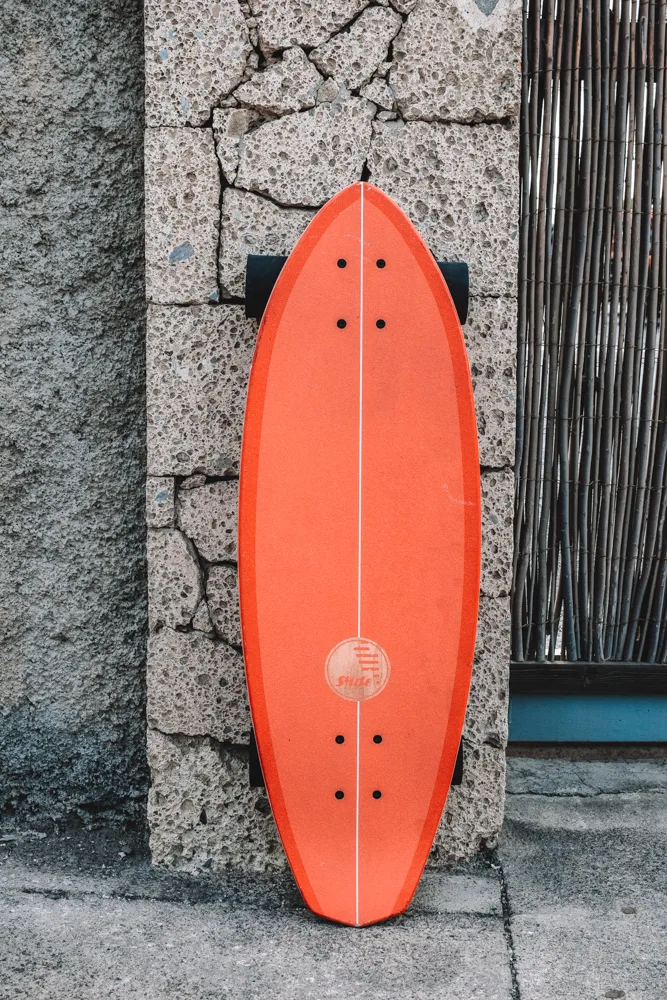
My Slide surfskate
Enjoy the process!
The simplest and most repetitive advice that you have probably already heard, but it is definitely the most important.
No matter what level you are in surfing, if you get to a point where you are not enjoying it, well let me tell you my dear friend that you aren’t going to accomplish anything.
All the effort and time that you are putting in this sport will be useless if you are not enjoying it. If you’re not enjoying it you will get frustrated, and as we’ve already seen, when you’re frustrated surfing will become harder for you.
If you’re not having fun, you will feel like you’re wasting your time, that you’re not learning anything new, and you will end up abandoning this sport.
Surfing is hard, but if you enjoy the process of learning, you’re sure to get there eventually!


Ale surfing in Lobitos, North Peru
Final thoughts on how hard is surfing
There you have it, the most thorough answer to the question “Is learning to surf hard?”
Learning to surf is hard. There is no easy way around it. Due to a combination of factors, which we have outlined in this article, surfing is one of those sports that just takes time, a lot of practice and patience to learn.
If you want to become a competent surfer with good form, follow the advice we gave you here, and you’re sure to have a rewarding experience.
There isn’t a single best way or best place to learn to surf, but there are things you can do to make your learning curve smoother.
Join surf sessions and classes with qualified instructors, choose the perfect waves for your level, the right surf essentials and maintain your body physically fit, and you’re off to a great start!
If you still have any questions about how hard is it to learn surfing, just let us know in the comments below!
Enjoyed reading is surfing hard to learn? Pin it!

