
If you have recently joined the wonderful world of water sports, you might be wondering, what’s the difference between a surfboard and a paddle board?
Or even, what is the difference between SUP and surfing?
There is quite a stark difference between the two, but at first glance, it might not be so obvious.
In this article we have outlined the most thorough answer to paddle board vs surfboard debate. By the end of this article, you will know exactly the difference between a surfboard and a paddle board, as well as the difference between SUP and surfing.
So what are you waiting for? Let’s dive in and discover them!


Greta doing SUP in Sardinia, Italy
Surfing vs paddle boarding differences
Before we can understand the differences between a SUP and a surf board, we need to understand the differences, and similarities between the two sports.
What is surfing?
Surfing is a sport where an individual uses a board to ride on the wall of a moving wave of water, which will usually carry the surfer towards the shore.
Surfers usually lie down on their board to paddle out to the line-up and to catch the wave, but will then do a surf pop up and stand up to surf the wave.
Depending on their surfing level, experienced surfers will often do fun manoeuvres in the waves. Surfers will often change the type of board they use depending on the waves.
The surfboard you use for big waves tends to be different from the one you would use for small waves.
There are numerous variations of surfing, like body boarding or kneeboarding, but for the purpose of this article, we will focus on traditional surfing.

Ale doing a tail snap on the lip while surfing in Tenerife, Spain
What is SUP?
SUP is the abbreviation of Stand Up Paddle.
This is a sport where individuals stand up on a board (hence the name) that is floating on top of the water in the sea (or lake, basically any body of water with calm water), and use a paddle to row themselves around and propel the board.
It’s usually done standing up, but for those with a more unstable balance, it can also be done while kneeling on the board.
Generally speaking, it’s a more relaxing sport than surfing, as it can be done on flat water to leisurely cruise along the coast, as opposed to riding waves and doing manoeuvres like you would in surfing.
But there are those who make it more thrilling, for example by doing sup yoga on a paddle board, or by surfing with a SUP.


Greta doing paddle boarding in Sardinia, Italy
But there are overlaps
This is where it gets tricky. Despite in theory being two distinct sports, there are many surfers out there that blur the lines between the sports, and surf huge waves with a paddle board.
This is usually called SUP surfing, as it’s a fusion of the two sports. They will usually do so with a special SUP surfing board, which is a paddle board that is adapted for surfing.
This is a bit different from the classic paddle board used for leisurely cruises. Despite the overlap, there is still a distinct difference between a paddle board and a surfboard, which we will look at next.


Greta surfing in Fuerteventura, Spain
Difference between paddle board and surfboard
When you first see one of those huge beginner surfboards, it’s easy to mistake it for a paddle board. After all, they’re both big floaty boards that people stand on.
However, there are actually a lot of differences between a surfboard and a paddle board. These come down to the following elements.
Size
If you place a tiny fibre short board next to a paddle board you will immediately see the difference in size.
However, when you place a paddle board next to a big foam surfboard, the differences aren’t so obvious to the untrained eye.


A 9ft Indio foam surfboard – perfect for beginners!
Generally speaking, surfboards are shorter, thinner and slimmer than paddle boards. Paddle boards are designed to be more stable, and as such they tend to be bigger, wider and thicker.
In terms of thickness, paddle boards are thicker, since this helps them become more buoyant and stable. Surfboards, even foam boards, tend to be less thick.
This because, even if you do need floatability to stand on a surfboard, you also need to be able to push it under incoming waves to duck dive.
Also, the thickness of a surfboard will change depending on the size and weight of the rider.


Going for a chill SUP cruise in Sardinia, Italy
In terms of length, SUPs are longer, as this also helps with their buoyancy and extra stability.
Surfboards tend to be short, depending on the height of the surfer, although you get also long boards which, as the name suggests, are obviously longer.
That said, you still wouldn’t confuse it for a SUP as the other features (thickness and width) are distinctly different.
Finally, in terms of width, paddle boards tend to be considerably wider, always to help with stability. Surfboards can’t be too wide, since you have to lie down on their deck and paddle with your arms.
If they were too wide, you simply wouldn’t be able to reach the water and paddle efficiently. For SUP you use an oar while standing up, and as such don’t have this reach problem.


Greta surfing in Tenerife, Spain
Material
Depending on the type of paddle board or surfboard, these can be made of completely different materials, or of similar ones.
Short boards for surfing are usually made of fibreglass or epoxy resin, whilst the big beginner boards are usually made with a foam core and soft top cover.
When it comes to paddle boards you can have either an inflatable sup or hard paddle boards. Inflatable paddle boards are usually made with a PVC material, that you then blow up and fill with air.
Rigid SUPs can be made with fibreglass, epoxy resin and foam, or a combination of all the above.


Greta using an inflatable paddle board in Sardinia, Italy
Shape
Similarly to the size, when you put a paddle board next to a surfboard, you will easily be able to spot the difference in shape.
Shorter boards for surfing will have a narrow nose and tail, to give advanced riders more manoeuvrability, and the ability to do quick turns in the water.
Paddle boards tend to have a wider and rounder shape, to help with floatability.
Foam surfboards for beginner surfers might resemble a SUP in shape, but you can still distinguish them thanks to the differences in size and material.


Greta’s 5.8ft Indio surfboard
But there are overlaps
As you will probably have guessed by now, there is some overlap in the defining characteristics of paddle boards and surfboards.
If you take big inflatable paddleboards, and compare them to a short fiberglass boards for surfing, the difference in size, shape and material is striking.
But if you take a big floaty beginner surfboard and a foam paddle board, the distinction between the two might not be as obvious.
Surfboards and paddle boards will sometimes have similar characteristics, depending on the skill level of the people using them, but they are still different types of boards and are used for different sports.
Despite the overlap, there are still more differences between surfboards and paddle boards than similarities.


Alejandro surfing in Tenerife, Spain
SUP vs Surfing FAQs
If you’re still not 100% clear on the difference between SUP and surfboard, here are some frequently asked questions to help you settle the surfing vs paddle boarding query forever.
Are paddle boards and surfboards the same?
No. They can be made of similar materials, and may have similar shapes, but they’re not the same.
Can you surf with a paddle board?
Yes. A paddle board that you use for surfing will be a bit different compared to a the inflatable sup boards used by SUP riders but there are definitely stand-up paddle boards out there that are used for surfing.


Going for a sunset SUP session with friends
Can you use a surfboard as a paddle board?
No. Surfboards are too small, light and unstable to be used as paddle boards.
Which is better: a SUP or a surfboard?
There is no direct answer to this question. You can’t really say which one is better, as it ultimately depends on what you plan to use the board for, and which sport you personally prefer.
Is SUP surfing the same as paddle boarding?
No. Surfing with a paddle board will generally still be considered surfing, whilst paddle boarding refers to using a SUP to go for a leisurely cruise along the coast.

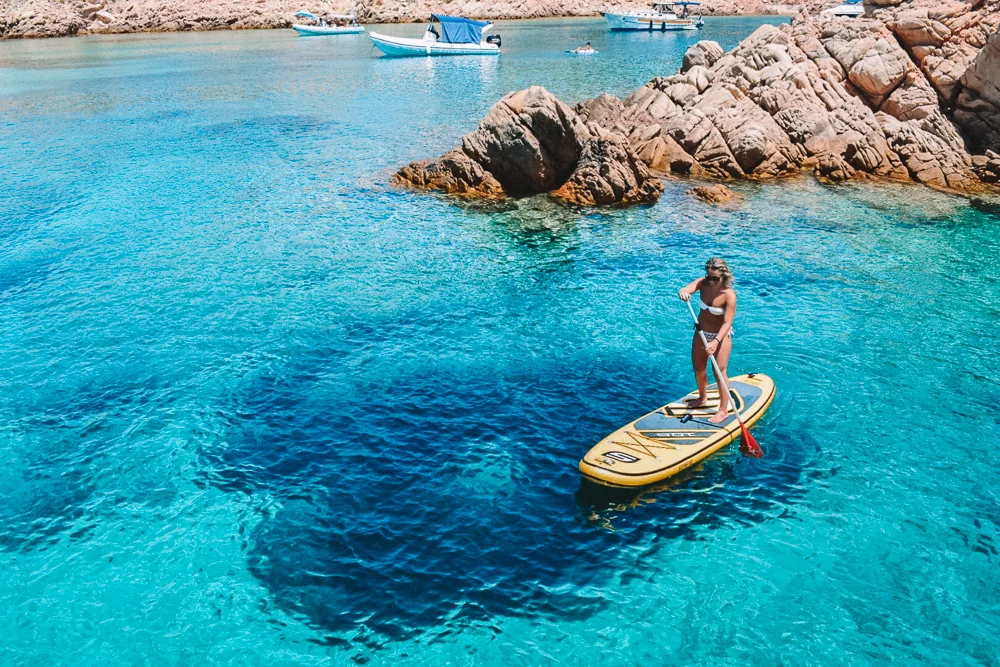
Greta doing SUP with an inflatable paddle board in Sardinia, Italy
Is surfing harder than SUP?
The general consensus is yes, surfing is harder than SUP.
It ultimately depends on your fitness level, what other sports you are used to doing, what your balance is like and many other factors, but generally speaking, surfing is considered harder than SUP.
SUP is easier to pick up, with a faster learning curve, and almost anyone can learn to do stand-up paddleboarding, whilst it’s hard to say how long it takes to learn to surf, as the process is different for everyone.


Ale surfing in Tenerife, Spain
Final thoughts on SUP vs surfboard
There you have it, the ultimate guide to settle the debate paddle board vs surfboard! Have you used a surfboard or paddle board before? How did you find it? Let us know in the comments below!
SUP and surfing are two very distinct sports, although there is often some overlap which, to the untrained eye, can be rather confusing. This is especially so when it comes to the boards used in these popular water sports.
Sometimes the major difference between a surfboard and a paddle board will be obvious, whilst other times it will be more subtle. Settling the paddle board vs surfboard debate is tricky, as there is no right answer.
The best paddle boards have different purposes from a regular surfboard, and even though both are used for water activities, they’re used for different things and sports.
It ultimately depends on what type of water sport you prefer doing, how you want to do it, and your own fitness level and surfing skills.
I hope you found this article useful in answering your SUP vs surfing questions! If you still have questions, just let us know in the comments below!
Enjoyed reading about the differences between paddle boarding vs surfing? Pin it!

